Hello,
as part of my research, I would like to generate parametric folded-plate models of composite bridges in order to investigate the development of stresses in the bridge deck slab during the construction phase.
At present, I am looking for a way to model the time-dependent development of strength, particularly tensile strength is of interest, according to DIN EN 1992 or the Model Code.
Unfortunately, I have not been able to find any relevant information on this either in the manuals or in the forum.
Could someone perhaps help me with how I could manually adjust or implement this?
Thanks in advance
Hi there
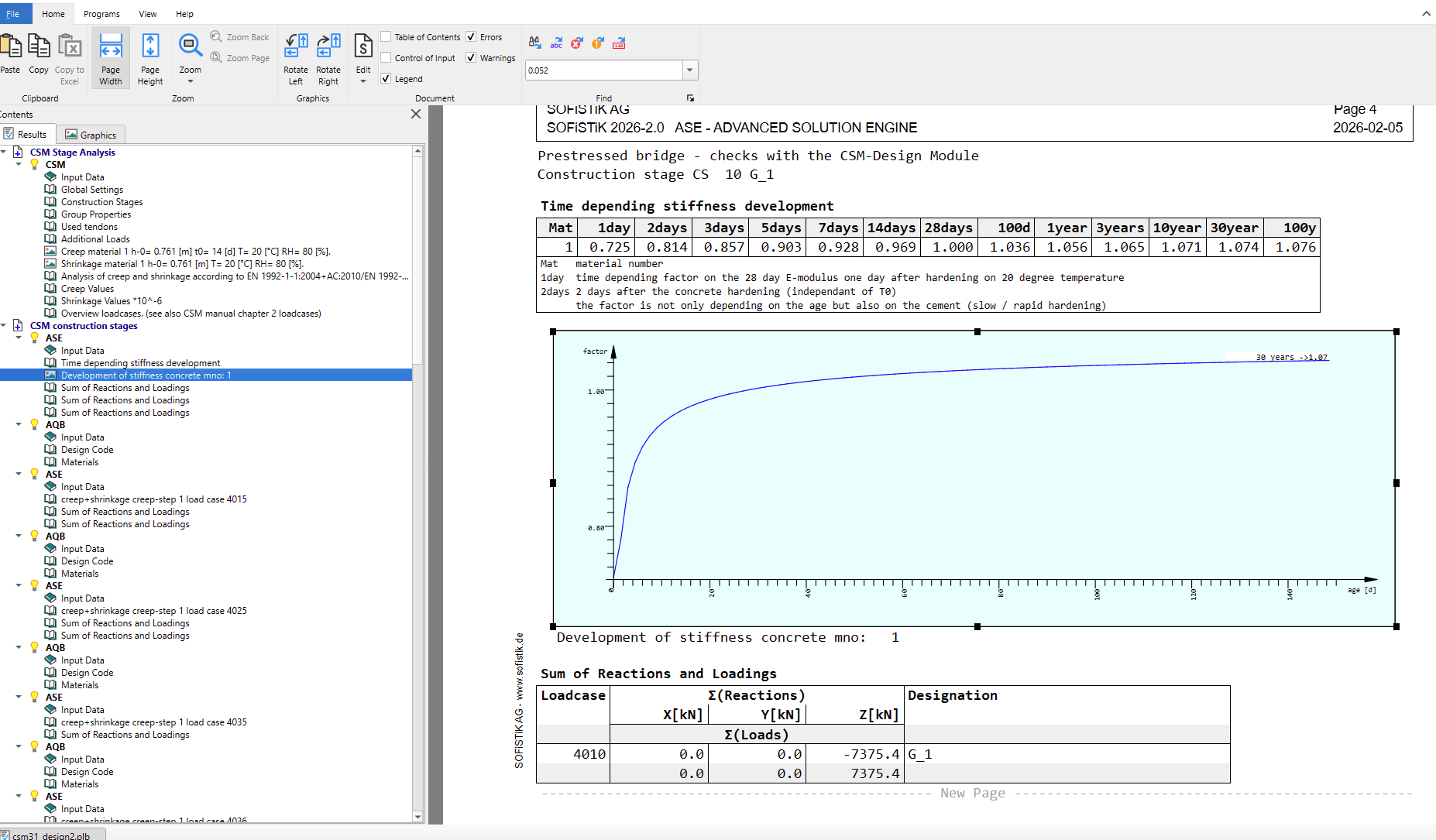
the time depending stiffness development is already included in the CSM
just take a look at the csm31_design.dat example in the example files.
But be cautious: the stresses calculated by command SPAN in AQB are referring to the E-Modul defined within AQUA.
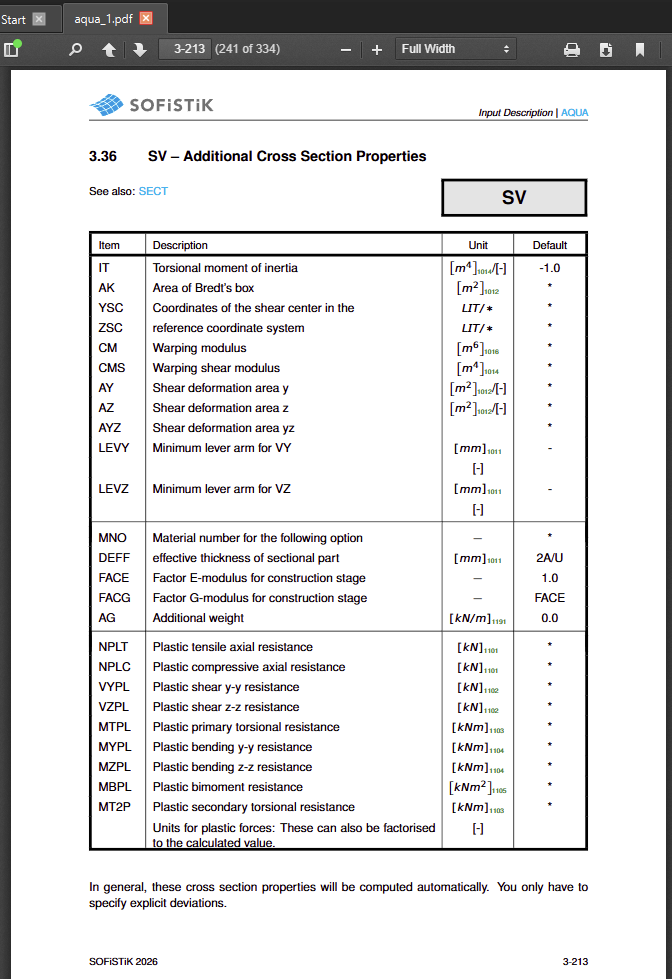
Maybe the command SV FACE helps you
Make yourself a simplified example and test it out.
Hi,
thanks for the response.
After posting yesterday i found the time depending stiffness development in CSM.
And i got it verifierd for concrete type “S”,”C” and “R” in a small Benchmark.
Regarding the calculation of stresses etc., please correct me if i’m worng, i understood the following:
- IN CSM all stages are defined with the correct time between them (T0,TS) incl. all c+s steps
- CSM defines ASE runs for all loadcases/ construction cases
- ASE uses the correct age of the concrete via “T1” which is calculated by CSM
- performing a non-linear analyses with “STEU ASE TEXT ‘SYST PROB NONL NMAT JA’ uses the time depending curve for E-Modules
- The ASE-Results for the CSM-cases contain all the non-lin. stresses in the concrete and the rebar with consideration to the concrete age
I don’t want to use AQB oder BEMESS because i don’t need any proof.
The non-linear stresses from ASE in the concrete and rebar are enought for me.
I’m mostly interested in the stresses in the concret slab during the construction stages.
Due to that i think the workflow i created should be sufficient for my needs
performing a non-linear analyses with “STEU ASE TEXT ‘SYST PROB NONL NMAT JA’ uses the time depending curve for E-Modules
This is not correct. Only a material linear analysis considers the concrete age. If you use PROB NONL you are calculating considering material non linear QUADs. In this case the nonlinear work law will be used
Thanks for the reply.
I’m aware, that Sofistik uses the non linear work law for PROB NONL. But I’m not 100% shure regarding the time depending effect of the E-Modules.
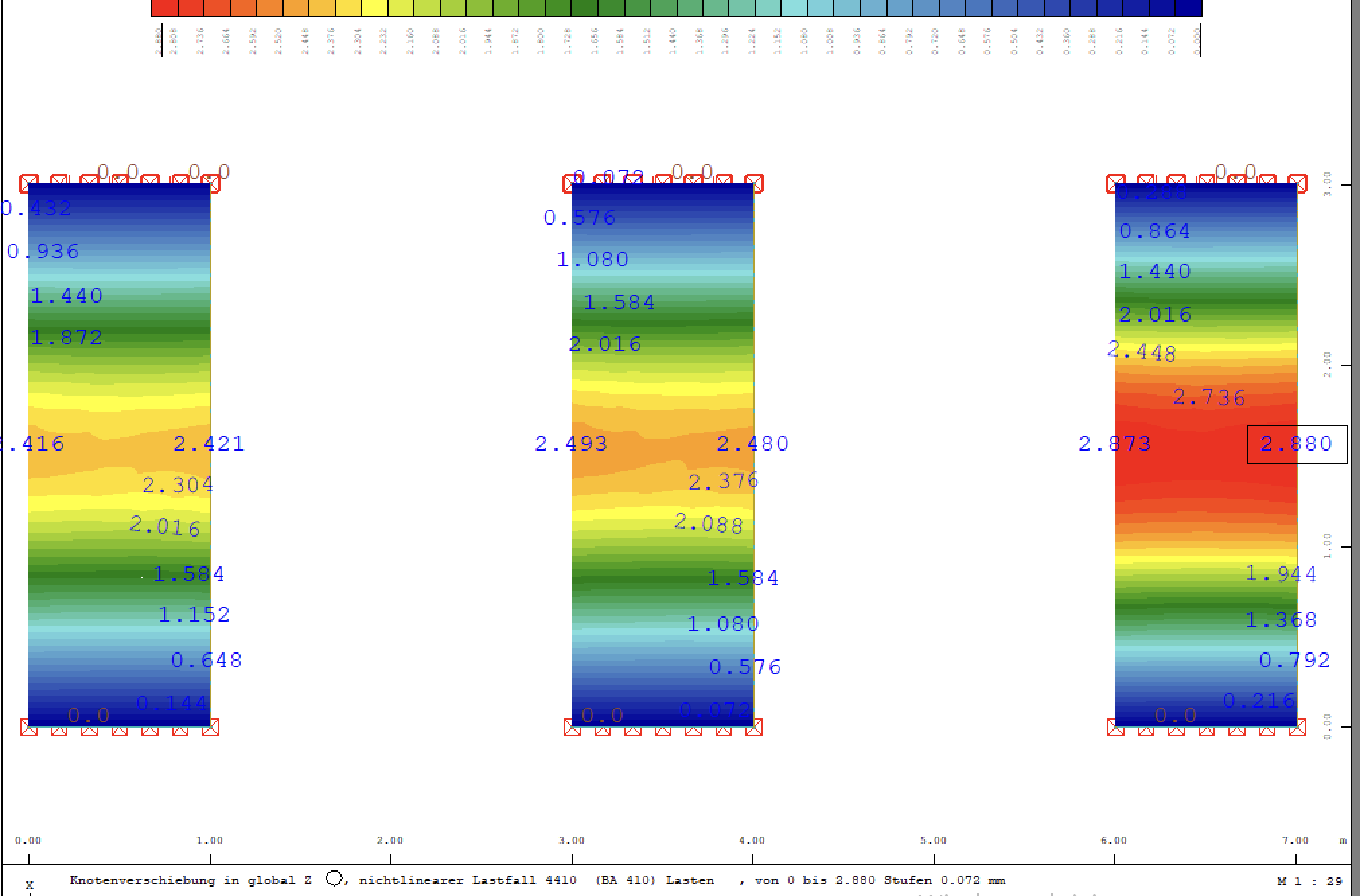
I created a small Benchmark with three slabs with a T0 (in CSM) of 1,10 and 1000 days for that case.
The slabs are loaded with a uniformal vertical load.
When I do a linear analysis the results match the time depending curve which is given in the CSM report.
The same ime dependent curve for the E-Modules is given in the report for PROB LINE and PROB NONL analysis.
When I perform the PROB NONL analysis the results don’t quite match the curve but the is an effect of the T0 noticeable. So I assume that Sofistik uses some sort of time dependent factor for the E-Modules and therefore for the calculation of the stresses etc.
Picture: Deformation in global z - slabs from left to right with T0 of 1,10 and 1000 days
Am i missing something here?
Do i need to perform mixed calculations in PROB LINE and PROB NONL to account for the time dependent effect of the concrete age?
My goal is to simulate the construction stages of a composite bridge and I want to calculate cracks and stresses in the concrete and rebar. Hence the need for the consideration of the concrete age.
may you upload your file?
There you go - thanks in advance
testfile.dat contains “custom” creep and shrinkage curves (set to 0 for Benchmark)
Benchmark_T_0.dat (4.5 KB)
testfile.dat (2.1 KB)
Interesting benchmark and thanks for sharing the files. Time-dependent concrete behavior is a critical aspect when modeling composite bridge construction stages, especially when evaluating stresses, cracking, and reinforcement performance. The influence of concrete age on stiffness, creep, and shrinkage can significantly affect the final results. It will be interesting to see whether the observed differences between PROB LINE and PROB NONL are related to the implementation of age-dependent material properties or nonlinear constitutive behavior. Looking forward to the findings and further discussion.