Hi
I have a bridge/tunnel consisting of bridge deck for railways, walls and foundation/deck for cars beneath the railways.
The structure is divided into to statical independent structures by a small grout/gap. One railway crosses the first structure, two railways cross the second one, and a fourth railway is crossing both.
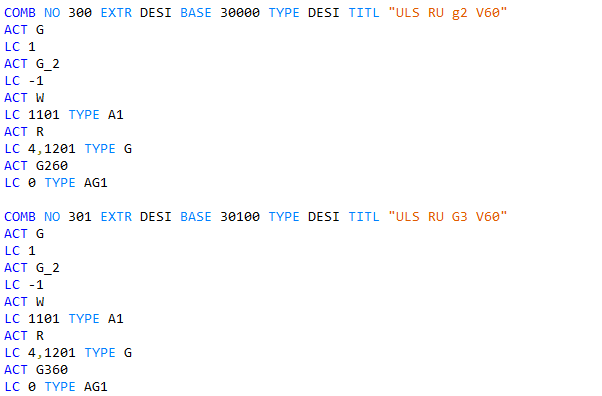
I have a lot of train load combinations for two tracks loaded defined in action “G260”, and a lot of train load combination for three og four tracks loaded, defined in action “G360”, with other load factors than for two tracks loaded.
The actions are defined as in the picture.

I have the two combination rules as below. Before, they where combined into one combination rule, where the last actions where included as “ACT G260, G360 LC 0 TYPE AG1”
Now the results I get for the shear forces in the bridge deck are smaller than before, for both 300 and 301 below.
And the shear forces in the bridge deck for maximum shear for both 300 and 301 are now equal for the deck with 1,5 railways (one railway, and one crossing), but this is not the case for the deck with 2,5 railways (2 railways and 1 crossing)
Does this make any sense?
In General, i think it is hard to understand how to define the loads right in combination rules, even though I have been reading a lot in the manual. So please tell me, if this is done wrong:
LC 1 is my dead load for the structure
G_2 is action for superimposed dead load, that includes LC 2 and LC3 for a fence and tracks
W is the wind, which I only want to act downwards towards the deck, as I have defined the load - and only if unfavorable.
R includes 4, 1201-1207, where 4 is the earth pressure on top of the deck, 1201 is the earth pressure on the side of the walls, and 1202-1207 are earth pressure on the walls due to the trains outside the bridge (these are not used in these first combinations)